
Two Masterclasses in Surgical Judgment: The Gisbert Richard and Kreissig Award Lectures
The Kreissig Award Lecture, named for Prof. Ingrid Kreissig (Germany), celebrates a lifetime of teaching minimalist, high-yield retinal surgery to generations of specialists. This year’s award went to Prof. Maria Berrocal (Puerto Rico), whose lecture was both a warning and a plea: Don’t abandon what has already stood the test of time.
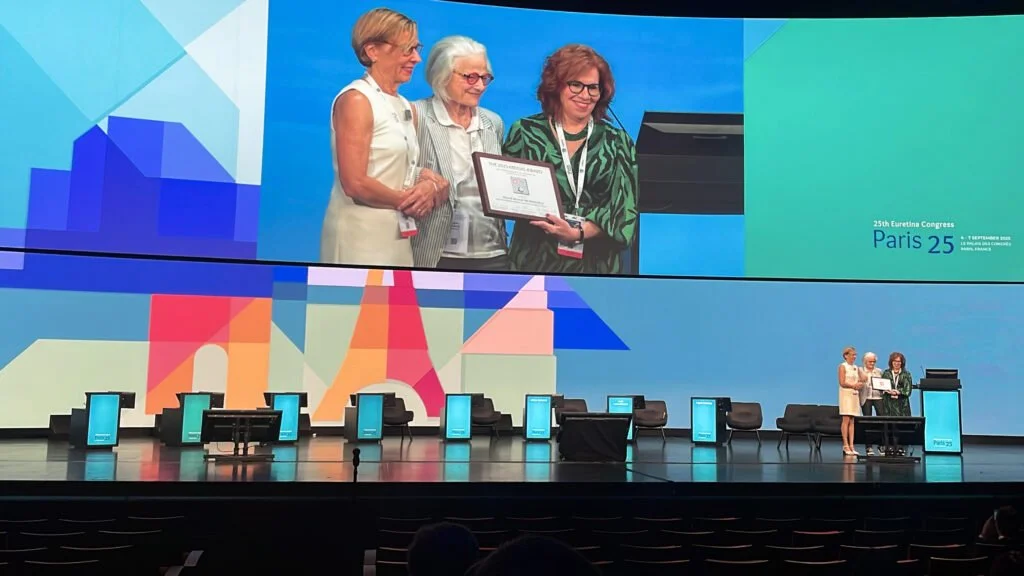
Presentation of the Kreissig Award to Prof. Maria Berrocal by Profs. Ingrid Kreissig and Anat Loewenstein
Rediscovering the power of proven therapies
Prof. Berrocal began with rhegmatogenous retinal detachment, where she noted a single surgery success rate of 91 percent for scleral buckling versus only 84 percent for vitrectomy. The advantage, she emphasized, is even more pronounced in phakic eyes. Prof. Berrocal also pointed out that minimal segmental buckling without drainage consistently produces the strongest long-term outcomes with fewer complications than vitrectomy.
To illustrate the point, she described a patient who had undergone both procedures-vitrectomy in one eye and a small buckle in the other. Both reached 20/20 acuity, but the postoperative journeys diverged sharply.
After vitrectomy, the patient endured nine weeks of disability; after the buckle, just two. The patient’s feedback was blunt: the second procedure was “fantastic,” because he could see immediately and did not have to endure head-down positioning.
Prof. Berrocal’s argument extended beyond detachment repair to an intriguing take on proliferative diabetic retinopathy (PDR): “Laser panretinal photocoagulation (PRP) is the standard of care for proliferative diabetic retinopathy.” PRP, she reminded the audience, induces durable regression that can last a decade or longer.
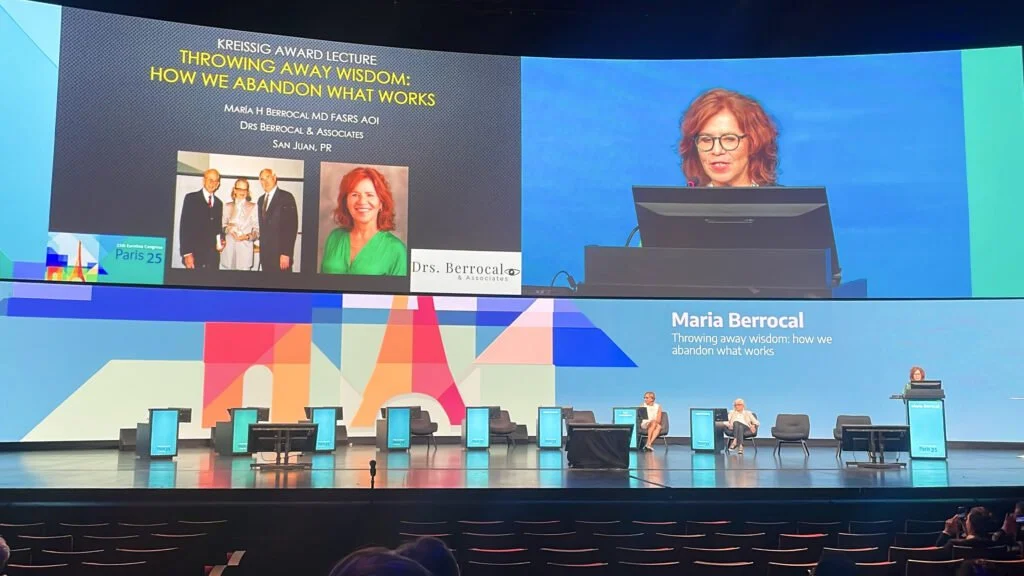
Anti-VEGF therapy, by contrast, only suppresses neovascularization temporarily and requires “continuous treatment forever.” That dependency, she warned, leaves patients highly vulnerable if they miss visits, and they often do.
The unsustainable cost of injections
The economic implications, too, are impossible to ignore. “In the United States, a quarter of all health money dollars go into treating diabetes complications. So if we just look at how many patients in the U. S. have proliferative diabetic retinopathy, we would require-just to treat proliferative diabetic retinopathy with injections-in one year, close to 4, 000, 000 injections. That’s over 300, 000 injections monthly.”
And the challenge doesn’t stop at America’s borders. With diabetes rates surging worldwide, she warned that the burden of injections on health systems would be nothing short of catastrophic. As she put it plainly, in many regions such demand would “bankrupt any health system.”
For her, there was one overarching takeaway illustrated by her discussion of supposed vitreoretinal relics like buckling and PRP. Innovation, she argued, should be measured not in fashion or novelty, but in what endures for patients and health systems alike.